
The front of a cat-food packet is a tiny billboard. Turn it around and you meet percentages, long chemical names and print apparently designed for a field mouse.
Learning how to read cat food labels makes that aisle much less bewildering. You do not need to declare one universal “best” food. You need to identify what the product is designed to do, whether it suits your cat’s life stage, how calorie-dense it is and which claims deserve less attention than their typeface suggests.
QUICK NAVIGATION In This Article
Quick Answer
Start with the nutritional adequacy or feeding-role statement, then check the species, life stage, calories, guaranteed analysis and feeding guide. Read ingredients for context, not as a quality scoreboard. When comparing wet and dry foods, account for their different moisture levels. Treat front-of-pack claims as advertising until the back label supports them.
Why Cat Nutrition Cannot Be Judged by the Front of the Pack
Cats are obligate carnivores. Their bodies depend on nutrients associated with animal tissues, including taurine, preformed vitamin A and arachidonic acid, alongside suitable protein, fat, vitamins and minerals. Cornell’s overview of the nutrients cats need also makes a useful point: more of a nutrient is not automatically better, and extra supplements are usually unnecessary when the main diet is complete and balanced.
That is why a charming ingredient on the front tells only a sliver of the story. “With salmon” cannot show whether the whole recipe supplies essential nutrients in appropriate amounts. “High protein” cannot tell you whether the calorie level suits a quiet indoor adult. The less glamorous lines on the back do far more work.
Rules and terminology differ between countries. US labels commonly refer to AAFCO profiles or feeding tests; UK and Australian packs often distinguish “complete” from “complementary.” Canadian products may use familiar North American formats. The practical question is universal: Is this meant to be the sole diet for this cat at this life stage?
How to Read Cat Food Labels in the Right Order
Many shoppers begin with the ingredient list. That is understandable—and backwards. Use this order instead.
1. Find the nutritional adequacy or feeding-role statement
This small sentence is the label’s job description. On a US product, look for language stating that the food is complete and balanced for a named life stage, based on an AAFCO nutrient profile or feeding-test procedure. The AAFCO guide to reading pet-food labels calls the adequacy statement a key part of matching food to an animal’s needs.
“Complete” means the diet is intended to provide all required nutrients; “balanced” means those nutrients are supplied in appropriate relationships. By contrast, “for intermittent or supplemental feeding only,” “complementary,” “topper” or “treat” tells you the product should not quietly become the entire menu unless a veterinarian has directed its use.
This distinction matters with appealing fish fillets and shredded-meat cans. A product can look wonderfully wholesome yet be designed only as a topper. Our Applaws wet cat food review and feeding-role analysis shows why the complete-versus-complementary line deserves more attention than the beauty shot on the front.
2. Match the species and life stage
Cat food is not small-dog food in a different packet. Confirm that the product is formulated for cats, then find the relevant life stage: growth or kitten, adult maintenance, gestation/lactation, senior where locally defined, or all life stages.
“All life stages” does not mean every cat should receive the same portion. It generally means the formula is designed to cover demanding stages such as growth and reproduction as well. A sedentary adult may need careful portioning, while a kitten needs enough energy and nutrients for growth. Cats with diagnosed health conditions may require a veterinarian’s individual recommendation rather than a supermarket label comparison.
3. Check calories before serving size
Two equally full bowls can deliver very different amounts of energy. Energy may appear per kilogram, 100 grams, cup, can, pouch or serving.
Use the per-can, per-pouch or weighed-gram figure to build a daily total. The feeding chart is a starting estimate, not a verdict handed down by the packet. Body condition, activity, age, neuter status, treats and health all affect needs. If your cat is gaining or losing weight unexpectedly, do not keep trimming or expanding portions indefinitely without veterinary input.
4. Read the guaranteed analysis for what it actually guarantees
In the standard US panel, crude protein and crude fat are minimums; fibre and moisture are maximums. These are regulatory boundaries, not a complete nutrient profile and not necessarily the exact amount in every serving. “Crude” describes the laboratory method—it does not mean poor quality.
The panel helps compare products with similar moisture. It becomes misleading when a dry kibble is placed beside a high-moisture food without adjustment. A wet food showing 10% protein can contain a substantial protein proportion once the water is removed from the calculation.
5. Use the ingredients list as context, not a league table
Ingredients are generally listed from greatest to least weight as they go into the recipe. Water-heavy fresh meat may therefore appear above a concentrated ingredient partly because of its moisture. Splitting related ingredients into several names can also change where each appears.
The list tells you what was included; it does not reveal digestibility, supplier standards, processing controls or the precise final amount of every ingredient. A first ingredient is not a complete nutritional verdict.
Nor is a long vitamin-and-mineral section automatically sinister. A complete food often needs carefully measured nutrient sources. If a term is unfamiliar, ask the manufacturer what it does rather than assuming that pronounceability determines safety.
6. Locate the maker, lot code and storage directions
A responsible label should identify the manufacturer or distributor. Keep the lot code and date information if a food seems unusual or your cat becomes unwell. Follow storage directions after opening.
What Each Label Section Can—and Cannot—Tell You
| Label detail | What it helps you answer | What it cannot prove |
| Feeding-role or adequacy statement | Is this designed as a main diet, and for which life stage? | That it is ideal for every individual cat |
| Calorie statement | How much energy is in a cup, can, pouch or measured weight? | The exact portion your cat personally needs |
| Guaranteed analysis | Minimum protein/fat and maximum fibre/moisture; sometimes extra nutrients | Exact values, digestibility or overall ingredient quality |
| Ingredients list | Which ingredients were used and their order by pre-processing weight | Precise quantities, final nutrient contribution or sourcing standards |
| Feeding guide | A sensible initial daily amount | A fixed prescription that ignores body condition and treats |
| Manufacturer and lot details | Who to question and how to identify a production batch | The answer to every quality-control question—ask the company |
Comparing Wet and Dry Cat Food Fairly
The water in wet food dilutes every “as fed” percentage printed on its panel. To compare foods with very different moisture levels, convert the nutrient to a dry-matter basis:
Dry-matter nutrient % = as-fed nutrient % ÷ (100 − moisture %) × 100
Suppose a wet food lists 10% protein and 78% moisture. Its dry matter is 22%. The calculation is 10 ÷ 22 × 100, or about 45% protein on a dry-matter basis. A kibble listing 36% protein and 10% moisture works out to 40% on a dry-matter basis. The wet food’s smaller printed number did not mean it contained less protein once water was excluded.
The FDA’s explanation of complete-and-balanced pet food and dry-matter comparisons confirms that guaranteed-analysis values are presented as fed, while nutrient profiles use a moisture-free basis.
This calculation is useful for broad comparison, but it does not turn the label into a laboratory report. Minimums and maximums remain limits rather than exact averages. If you need precise phosphorus, sodium or another nutrient for a medical reason, request typical analysis data from the manufacturer and let your veterinarian interpret it.
Practical Feeding Guidelines That Turn Labels into Better Decisions
Once the packet passes the feeding-role and life-stage checks, move from label reading to daily routine.
- Choose the correct main diet. Build most meals around a complete food appropriate for your cat’s stage and circumstances.
- Measure calories, not just scoops. A kitchen scale can be more consistent than a cup filled differently each morning. Include treats and toppers in the daily total.
- Change food gradually. Mix increasing amounts of the new diet over several days, moving more slowly if your cat is sensitive. A sudden refusal to eat, vomiting or persistent diarrhoea deserves prompt veterinary advice.
- Watch the cat, not only the packet. Monitor appetite, stools, coat, energy, body weight and body condition. A food can meet standards yet not suit every individual.
- Protect freshness. Keep dry food sealed, wash bowls regularly, refrigerate opened wet food promptly and follow the storage directions.
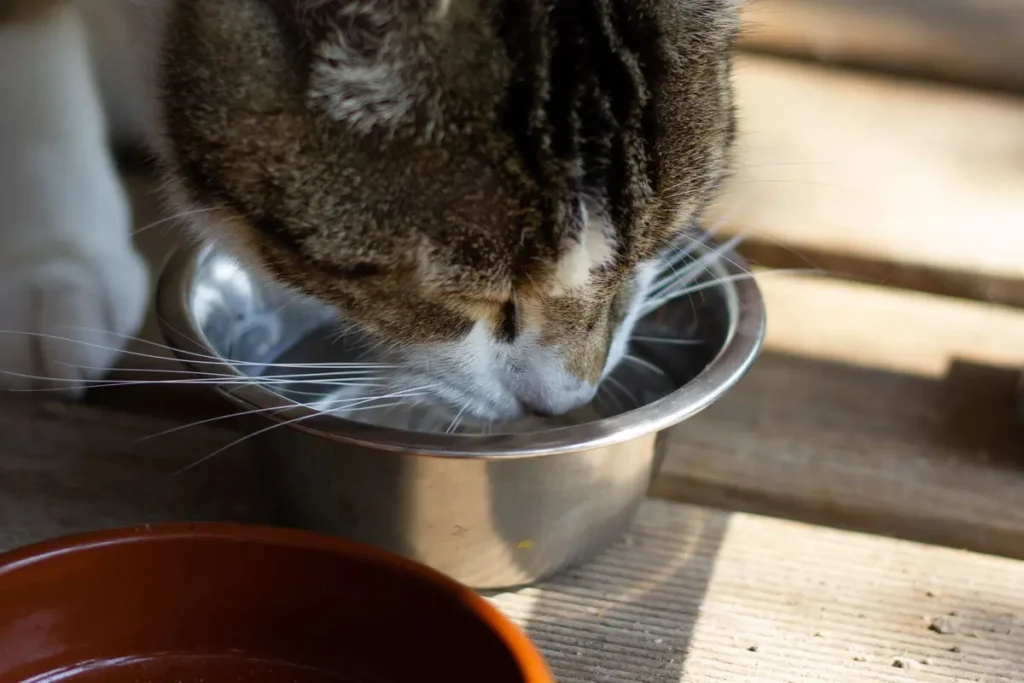
- Keep fresh water available. Wet food contributes water, but it does not remove the need for clean drinking options. Place bowls away from litter trays and refresh them often.
- Reassess at life changes. Kittenhood, pregnancy, ageing, major activity changes and medical diagnoses can all change the decision. Our guide to the healthiest cat foods for different life stages is a useful next step after you learn to decode the pack.
Cat-Food Label Myths Worth Leaving on the Shelf
“The first ingredient tells me everything”
It tells you which ingredient weighed most before processing. It does not provide a nutrient balance, digestibility score or quality-control report. Read it, but do not let it outrank the adequacy statement, calories and your cat’s needs.
“By-products are automatically bad”
Named and properly defined animal by-products can include nutrient-rich organs. The word alone does not establish whether a finished food is excellent or poor. Manufacturer transparency, formulation expertise, safety testing and the complete nutrient profile offer more useful questions.
“Grain-free means low-carbohydrate or healthier”
Removing grain does not remove starch; peas, potatoes or other ingredients may take its place. Some cats have specific dietary needs, but “grain-free” is not a universal quality grade.
“Natural, premium and holistic mean nutritionally complete”
Front-label terms can influence mood without answering the main question. A beautiful “natural” topper may still be complementary. Find the formal feeding-role statement.
“If taurine is not named, the food must be deficient”
Taurine can be supplied by ingredients and/or added as a supplement. What matters for a main diet is whether the finished food is substantiated as nutritionally complete for cats and the appropriate life stage. Do not add taurine or other nutrients “just in case”; excess or imbalance can create new problems.
When the Label Is Not Enough
Call the manufacturer if you need typical nutrient values, sourcing information, digestibility data, quality-control practices or clarification of regional packaging. Keep the product name and lot code handy.
Speak with a veterinarian before choosing a diet for a cat with kidney, urinary, gastrointestinal, endocrine, allergy-related or weight concerns. Seek veterinary care promptly for a cat that stops eating, repeatedly vomits, develops ongoing diarrhoea, loses weight unexpectedly, drinks or urinates markedly more, or seems weak or painful. Those signs need an individual assessment, not another hour comparing ingredient lists.
Frequently Asked Questions
What should I look for first on a cat food label?
Look first for the nutritional adequacy or feeding-role statement. It tells you whether the product is complete and balanced for a particular life stage or intended only for complementary, supplemental or intermittent feeding. Then check calories, guaranteed analysis, ingredients, feeding directions and manufacturer details.
How do I compare protein in wet and dry cat food?
Compare protein on a dry-matter basis because wet food contains much more water. Divide the as-fed protein percentage by 100 minus the moisture percentage, then multiply by 100. Remember that guaranteed-analysis protein is usually a minimum, so the result is a useful estimate rather than an exact recipe value.
Does “complete and balanced” mean a cat food is high quality?
It means the food has been substantiated to provide required nutrients in appropriate proportions for the stated species and life stage; it does not rank flavour, sourcing, digestibility or suitability for one individual cat. Treat it as an essential first filter, then consider calories, company transparency and your cat’s response.
Are meat by-products bad for cats?
Meat by-products are not automatically bad for cats. Properly defined by-products may include nutritious organs, and a single ingredient name cannot reveal the finished food’s overall quality. Check the food’s adequacy, life-stage fit and manufacturer standards, and ask the company for clarification if the source description is vague.
A Better Label Habit Starts at the Back
Knowing how to read cat food labels does not require memorising every additive or choosing sides in the wet-versus-dry debate. Begin with feeding purpose and life stage, compare calories and nutrients fairly, and let the ingredients list add context—not panic.
The packet will keep shouting from the front. You now know where the quieter, more useful answers live.
What is the strangest or most confusing claim you have seen on your cat’s food? Share your cat’s dining quirks and label questions in the comments.
Safety and nutrition note: This article offers general educational information, not an individual diet plan or veterinary diagnosis. Cats with health conditions, appetite changes or special nutritional needs should be assessed by a veterinarian.