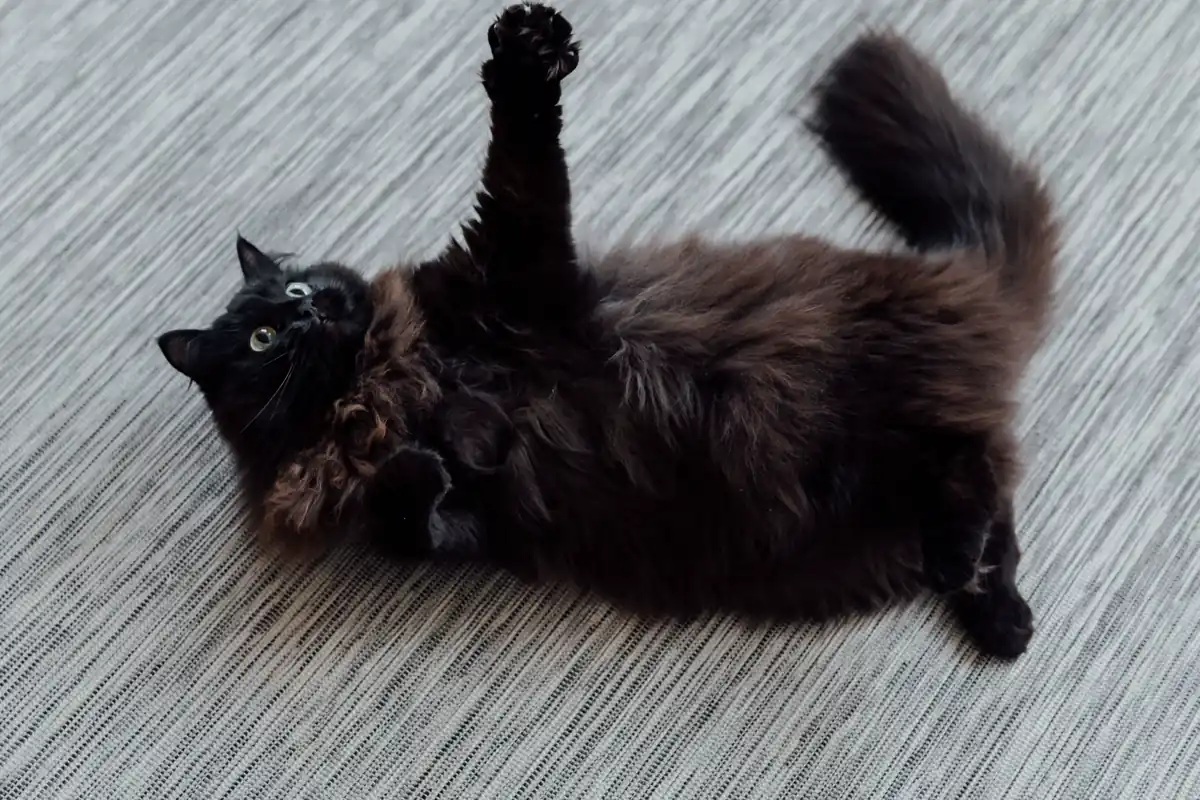

You walk into the room. Your cat spots you, takes two determined steps and then—flump—drops sideways as if their tiny legs have clocked out for the day. Sometimes there is a stretch. Sometimes four paws point at the ceiling. Naturally, you wonder: why does my cat flop down in front of me?
That dramatic little floor routine is often friendly and completely normal. The trick is reading the rest of the cat, because the same basic movement can mean “hello,” “play with me,” “look at me,” or simply “this patch of floor feels excellent.”
Quick answer: Cats commonly flop down in front of people as a relaxed greeting, a sign of trust, a request for attention or an invitation to play. They may also be stretching, enjoying a comfortable surface, reacting to catnip or displaying mating behaviour. Body tension, ears, eyes and tail reveal which explanation fits.
QUICK NAVIGATION In This Article
What Does a Cat “Flop” Actually Look Like?
A typical happy flop is deliberate. Your cat approaches or watches you, lowers one shoulder and rolls onto a side or back. Their body looks loose rather than rigid. They may stretch their toes, curve their paws, wriggle against the floor or gaze up at you as if expecting applause.
This is different from a cat losing balance. A relaxed cat chooses the movement and can stand normally afterwards. A cat that staggers, seems weak, cannot rise or suddenly falls without control needs veterinary attention.
Context matters too. A flop beside your feet when you arrive home probably carries a different message from rolling wildly after catnip or repeatedly calling and rolling while in heat.
Why Does My Cat Flop Down in Front of Me? 7 Likely Reasons
1. Your cat is giving you an enthusiastic hello
For some cats, the flop is a greeting with theatrical direction. You have returned from the kitchen, the garden or an exhausting forty-second trip to the hallway, and your cat would like the reunion formally acknowledged.
Cats Protection describes rolling onto the back after a period of separation as a common greeting, particularly around trusted people. If the flop regularly happens when you come home, the timing is a powerful clue.
Your cat may add other friendly signals:
- A tail held upright before the flop
- Relaxed or half-closed eyes
- A small chirp, trill or soft meow
- Cheek rubbing
- A slow blink
- Loose paws and smooth fur
If greetings are often vocal as well as acrobatic, our explanation of why a cat meows when you leave the room explores attention, routine and separation-related clues in more detail.
2. They feel safe enough to relax near you
The belly is physically vulnerable. A cat who exposes it while loose and calm is showing that they do not feel an immediate need to protect themselves. That is meaningful trust—but it is not a signed contract for tummy tickles.
The RSPCA guide to cat body language lists rolling over among relaxed behaviours and stresses looking at the eyes, tail, fur and posture together. A soft cat is very different from a tense cat lying partly on one side with flattened ears and wide pupils.
Think of the flop as your cat saying, “I can let my guard down here.” That is already a compliment. No belly access required.
3. Your cat has learned that flopping gets attention
Cats are excellent students of human behaviour. If a dramatic roll makes you laugh, speak, crouch down or fetch a toy, your cat may repeat it because the performance works.
This does not make the gesture fake. A learned greeting can still be affectionate. It simply means your cat has discovered a dependable button marked “activate human.”
Look at what happens next. Does your cat glance towards you and then towards the toy basket? Do they get up and lead you to the kitchen? Do they rub their cheek against your hand? The follow-up often explains the opening act.
4. It is an invitation to play
A playful flop tends to have energy behind it. Your cat may roll, grab at the air, kick with the back feet, dart away and return, or stare at a nearby toy. Large pupils can appear during exciting play, so interpret them alongside forward-facing ears and springy movement rather than in isolation.
Offer a wand toy, kicker toy or soft ball instead of wiggling your fingers near the belly. Moving a toy away from the cat gives them a safer target for stalking and pouncing.
Regular interactive play is part of a well-rounded routine. Our basic cat-care guide for new owners covers play and enrichment alongside grooming, feeding and preventive care.
5. They are stretching or getting comfortable
Sometimes the answer is wonderfully uncomplicated: your cat wanted a stretch.
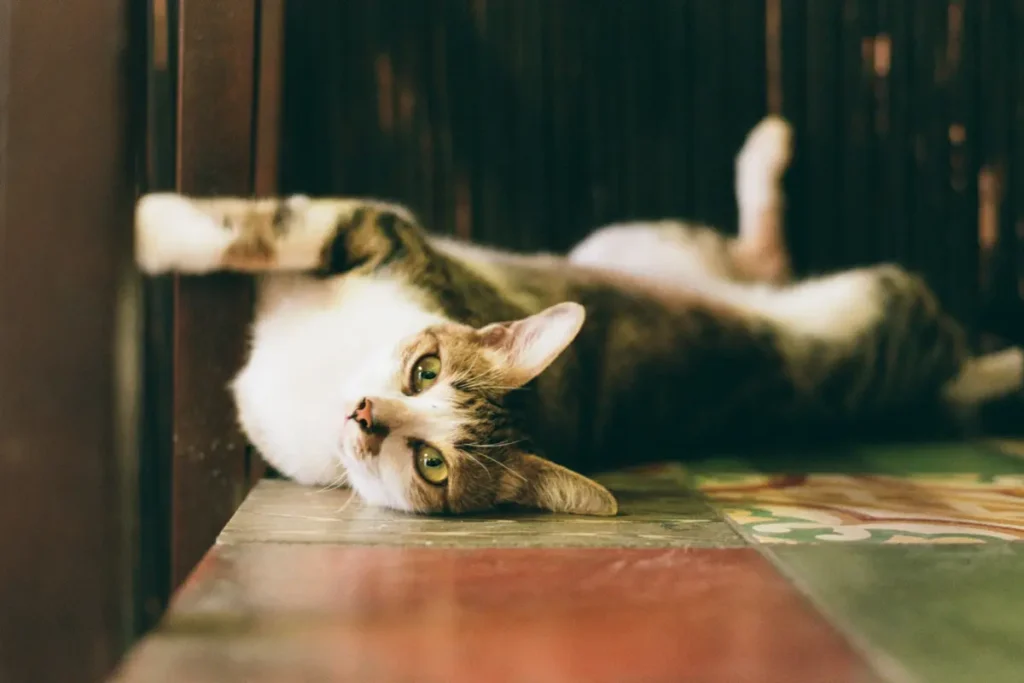
After sleeping curled into a shape that would alarm a yoga instructor, a cat may roll onto one side, lengthen the spine and extend the legs. A warm rug, sunny floorboard or cool tile can also become the chosen stage. If your cat settles there and dozes, the flop was probably the feline equivalent of sinking into a favourite chair.
Cats Protection’s current guide to why cats roll on their backs includes greeting, attention, stretching, resting and sleep among the common explanations. That range is useful: not every cute posture is a coded message.
6. Catnip has switched on roll mode
If the flop follows a sniff of catnip, the mystery may already be solved. Responsive cats can become wriggly, playful, excitable or deeply relaxed for a short period. Rolling and rubbing are common parts of the reaction.
Not every cat responds to catnip, and kittens may show little interest. If your cat does enjoy it, offer a modest amount in a safe space and let them choose whether to engage. There is no need to keep adding more because the first pinch did not produce a viral-video performance.
7. An unspayed female may be in heat
An unspayed female cat in heat may become unusually affectionate, vocal and restless. She may roll repeatedly, raise her hindquarters, move her tail to one side or tread with her back feet.
This is reproductive behaviour rather than a quirky greeting. Keep her securely indoors and speak with your veterinarian about spaying and pregnancy prevention. Do not allow unsupervised outdoor access while she is in heat.
Decode the Flop: What the Rest of the Body Says
One posture never tells the whole story. Use this quick table to read the scene rather than the belly alone.
| What you notice | Most likely message | A good response |
| Loose body, soft eyes, upright tail beforehand | Friendly greeting or relaxed trust | Speak softly, slow-blink or offer a cheek stroke |
| Rolling, pawing, quick dashes, focused gaze | Play invitation | Bring out a wand or soft chase toy |
| Flop followed by looking at you or walking towards a resource | Attention or a learned request | Check what your cat needs without rewarding frantic behaviour |
| Long stretch followed by resting | Comfort, stretching or sleep | Let the professional lounger enjoy the floor |
| Tail lashing, ears turning back, skin twitching | Rising arousal or overstimulation | Stop touching and give space |
| Repeated rolling with loud calling in an unspayed female | Possible heat behaviour | Keep her indoors and contact your vet about spaying |
| Wobbling, uncontrolled fall, weakness or inability to stand | Possible medical problem | Contact a veterinarian promptly |
Does the Flop Mean “Rub My Belly”?
Usually, no.
This is where many friendly encounters go sideways. A cat exposes their stomach, the human sees premium fluff, and a hand descends. One second later, the hand has been captured by four paws and several firm opinions.
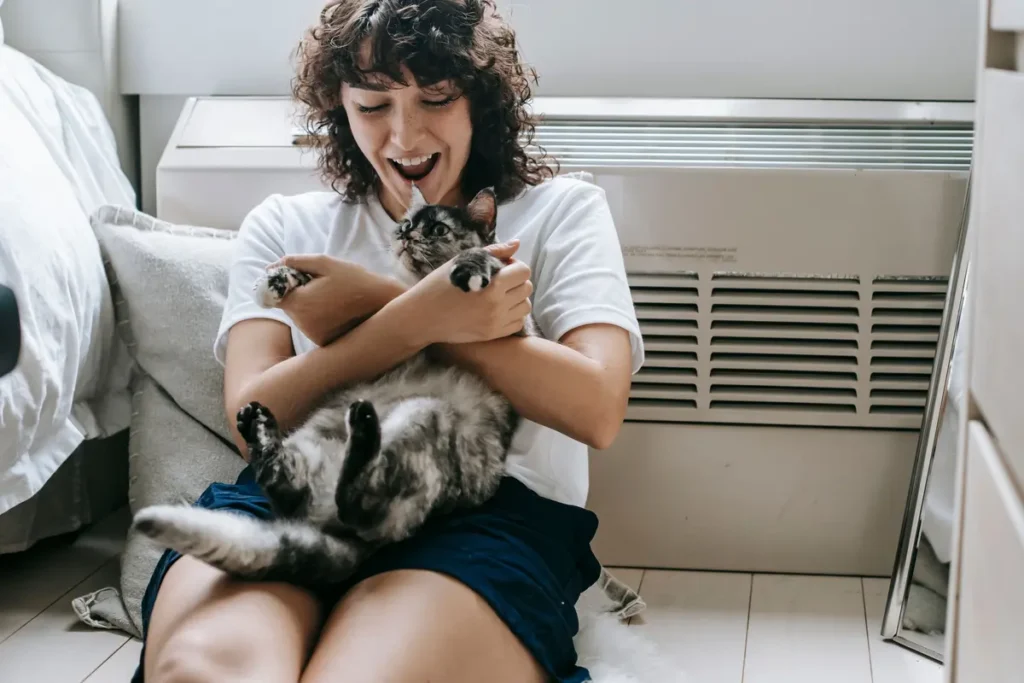
According to Cats Protection’s advice on petting a cat, showing the belly usually signals comfort and trust rather than permission to touch that sensitive area. Many cats prefer contact around the cheeks, chin or top of the head.
Some individual cats genuinely enjoy belly rubs. Let behaviour—not optimism—tell you. A cat who remains loose and leans into gentle contact may be comfortable. Stop immediately if the tail flicks, ears rotate back, pupils widen, skin ripples or paws begin closing around your hand.
How to Respond Without Ruining the Moment
1. Pause and read the whole cat
Check the ears, eyes, tail and muscle tension. A relaxed roll invites calm social contact; a tense sideways posture asks for distance.
2. Acknowledge the greeting
Try a soft hello or slow blink. You do not have to touch every cat who approaches. Quiet attention can be rewarding on its own.
3. Let your cat choose contact
Offer a relaxed hand near the cheek rather than reaching over the belly. If your cat rubs against it, a brief cheek or chin stroke is a sensible place to start.
4. Redirect playful paws to a toy
If your cat grabs, bunny-kicks or darts away, move the game onto a suitable toy. Keep hands and feet out of the hunting sequence. Allow the cat to catch the toy occasionally so the game has a satisfying finish.
5. Notice the pattern
Does the flop happen after work, before dinner, beside the toy drawer or on warm afternoons? The repeated context often reveals more than the pose itself.
What Cat Owners Should Avoid
- Do not assume the belly is available. Trust can disappear quickly when a sensitive area is grabbed.
- Do not punish a swat or bite after ignoring warning signs. Pause interaction and learn the cat’s earlier signals.
- Do not wrestle with bare hands. This can teach a playful cat that human skin is an acceptable target.
- Do not hold the cat down for affection. Let them control when contact starts and stops.
- Do not treat every flop as dominance, manipulation or anxiety. Those labels often add drama without improving understanding.
- Do not ignore an uncontrolled fall. A playful roll and a loss of balance are not the same event.
When the Behaviour May Need Attention
A familiar, deliberate flop from a bright, coordinated cat is usually harmless. Contact your veterinarian if the movement is new, uncontrolled or accompanied by:
- Staggering, circling or repeated loss of balance
- Weakness, collapse or difficulty standing
- A head tilt or unusual eye movement
- Crying, hiding or obvious pain
- Limping or reluctance to jump
- Breathing difficulty
- Vomiting, loss of appetite or marked tiredness
- Sudden aggression when a particular body area is approached
- A major change in normal behaviour or social interest
Seek urgent veterinary care for collapse, breathing trouble, seizures, severe weakness or suspected toxin exposure. If you are unsure whether you saw a playful flop or a fall, record a video only when it is safe to do so and contact your clinic for guidance.
Frequently Asked Questions
Why does my cat flop down when they see me?
Your cat may be greeting you, showing they feel safe or asking for attention. A loose body, soft eyes and relaxed ears support a friendly explanation. The timing matters: a flop immediately after you return home is especially likely to be a social greeting.
Is cat flopping a sign of affection?
It can be a sign of affection and trust, but it is not proof by itself. Cats also flop to stretch, rest, play, react to catnip or gain attention. Read the movement together with the tail, ears, eyes and situation.
Why does my cat roll over and then bite me?
Your cat may become overstimulated or may treat the moving hand as prey. Exposing the belly usually does not mean the cat wants it rubbed. Stop at early warning signs and redirect playful grabbing towards a wand or kicker toy.
Should I worry if my cat suddenly falls onto their side?
A controlled roll from an alert cat is usually normal. An uncontrolled fall, wobbling, weakness, head tilt, confusion or difficulty standing is different and should be discussed with a veterinarian promptly. Collapse, seizures or breathing trouble require urgent care.
The Flop Is Funny—The Context Is the Translation
So, why does my cat flop down in front of me? Most often, your cat is greeting you, relaxing in your company, requesting attention or launching a play session with maximum dramatic effect. Sometimes they are simply stretching on a very acceptable patch of floor.
Enjoy the performance, but let your cat set the rules. Read the whole body, offer attention around the cheeks or chin, and use toys when the paws get playful. The best response is not automatically a belly rub; it is showing your cat that their signals make sense to you.
Does your cat perform a gentle side-flop, a full belly-up roll or an Oscar-worthy collapse at your feet? Share their funniest version in the comments.
Behaviour and veterinary disclaimer: This article provides general educational information and does not replace individual advice, diagnosis or treatment from a veterinarian or qualified feline behaviour professional.